
-
Our latest News
Where are we located – Pierre Close, Mt Colah

Meeting Times
Cubs (8-10)
Wednesday 6.30pm – 8.00pm
Scouts (11-13)
Monday 6.30pm – 8.30pm
Venturers (14-17)
Wednesday 7.00pm – 9.00pm
Rovers (18-23)
Monday 8.00pm – 10.00pm
Follow Us on Facebook
Current Term Program
Our current term programs are available via our closed Facebook group.
Countdown to Xmas Trees 2023
Xmas Tree FundraiserDecember 9, 2023Live Christmas Trees are back! Pick up a tree at Hunt Reserve, or pre order one online - Click the link above to order your treeComing Soon
Australian JamboreeJanuary 6, 2025Countdown is on to this Huge Event in the Scouting CalendarBlogroll
-
Archives
More Bush Tucker – Lilli Pilli Jam

At this time of year, if you keep your eye open, you can find tall trees in the Sydney North Region with clusters of vibrantly coloured berries. These are native plants called lilli pillis. What many people don’t know is that these fruit are very edible and make an excellent jam. When you pick them off the tree and eat them straight away that have a slight tart taste, a bit like a sour apple, but when you boil them and make them into a jam or jelly, they have a unique and delicious taste.
 Ari and I had a quick drive around our streets looking for lilli pillis. Within 10 minutes I found a house in Berowra with massive trees with large clusters of lilli pillis. I knocked on the door, and asked the owner if I could take them. She had no use for them, and within 10 minutes we had 2 buckets full of delicious berries!
After picking, I washed them and picked out the leaves and small sticks. I was about to “deseed” them but realised that this would take me days. So, I boiled them instead and strained the syrup through a muslin cloth. The recipe that I found on the net didn’t use the berries after this process, and discarded them but it seemed to be a shame to throw them out after taking the juice out. So, I took the seeds out from each one. This didn’t take long as the lilli pillis were cooked – about half an hour.
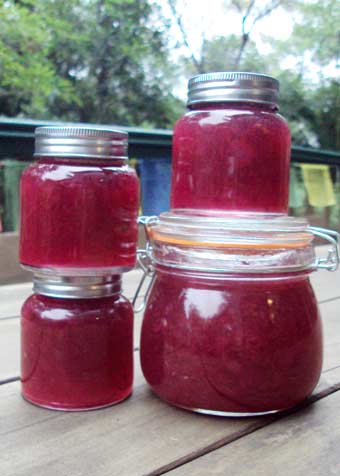
The recipe for lilli pilli jam is very simple: Mix 250gms of lilli pillis and their juice, to 250gms of sugar, and the juice of one lemon. Mix the lot and boil. I bought a sachet of pectin to throw in, to aid setting.
I had my first batch of lilli pilli jam made not long after. After boiling it for about 10 minutes it turns into a vibrant purple. The jars are now in the fridge cooling down. I’m really looking forward to having some for breakfast tomorrow!
Posted in Venturer News
Tagged berowra, bush tucker, lilli pilli jam, lilli pillis, Sydney North Region
How to Build an Emergency Home in a Day

Sandbags, dirt and barbed wire are all that's needed to start building an earthquake proof shelter like this!
I stumbled upon this info years ago, when I was looking for designs on adobe buildings. Recently I was chatting to Jake Cassar – The Bush Tucker Man, and I thought it would be great to share this info with him and those that are interested in the type of work that he does. This one’s for you Jake…
Build an earthquake proof home within a day!
Extract the from Cal-Earth website…
After a fire, hurricane, flood, or earthquake we immediately declare that this was a natural disaster, an act of God. The right question is why did our house burn, fall apart, or get swept away? And when we have the chance to re-build it, why should we build it the same way and in the same place? Ultimately “natural disasters” are human created disasters blamed on nature.
“To build simple emergency and safe structures in our backyards, to give us maximum safety with minimum environmental impact, we must choose natural materials and, like nature itself, build with minimum materials to create maximum space, like a beehive or a sea shell. The strongest structures in nature which work in tune with gravity, friction, minimum exposure and maximum compression, are arches, domes and vault forms. And they can be easily learned and utilize the most available material on earth: Earth.”
– Nader Khalili
Architect and author Nader Khalili developed this simple breakthrough building technology known as Superadobe (sandbags and barbed wire) and Ceramic Houses, with the freely available material of earth, for almost thirty years.
 Khalili believes that the whole family should be able to build together, men and women, from grandma to the youngest child. As such, we have spent many years researching hands-on how to make the process simpler and easier. There should be no heavy lifting or backaches, no expensive equipment, and a flexible and fast construction. The bags are filled in place on the wall using small pots like coffee cans, or even kitchen utensils. You can build alone or as a group.
The structural principles of the timeless forms of arches, domes, vaults, and apses are built with the materials of earth, sandbags and barbed wire using the engineering of single and double curvature compression shell structures, to reach the ultimate in strength, self-help, and aesthetics. In Superadobe, the ancient earth architecture of the Middle East using sun-dried mud bricks is fused with its portable nomadic culture of fabrics and tensile elements, not just through design and pattern, but through the structure itself. Structural design uses modern engineering concepts like base-isolation and post-tensioning. The innovation of barbed wire adds the tensile element to the traditional earthen structures, creating earthquake resistance despite the earth’s low shear strength. The aerodynamic forms resist hurricanes. The innovation of sandbags adds flood resistance, and easy construction, while the earth itself provides insulation and fire-proofing.
It’s a proven technology, it’s cost effective, you need very little building material, just what nature gives you. So simple it can be learned by everybody.
MCMK Venturers | Aboriginal Cave Paintings
Posted in Venturer News
Tagged Aboriginal cave paintings, MCMK, Mount Kuring Gai, Sydney North, Sydney North Venturers
 1st Mt Colah / Mt Kuring-gai Scout Group